A few years ago, watching live sports online still felt like a backup plan. You used it when cable was too expensive, when you were traveling, or when the game was stuck behind the wrong package. That gap is closing fast. The future of sports streaming is not about whether fans will switch. It is about which platforms can deliver every game, every device, and every big moment without delay, blackout confusion, or extra monthly costs.
For viewers in the U.S. and Canada, the shift is already obvious. Premium leagues are spreading across more apps, regional coverage is changing, and the old cable bundle is losing its grip. Fans want live access, stable quality, and one place to watch without juggling five subscriptions. That demand is shaping the market faster than any marketing campaign ever could.
The future of sports streaming will be defined by access
The biggest issue is not technology alone. It is access. Fans do not just want sharp video. They want the right game, in the right market, on the right night, without signing up for another platform at kickoff.
That is why the future of sports streaming will reward services that reduce friction. If a viewer has to sort through blackout rules, exclusive app deals, regional restrictions, and separate logins, the experience starts to feel worse than cable, not better. Convenience is becoming the real product.
Leagues understand this, but they are also chasing media rights revenue. That creates a tension. On one side, the business wants exclusivity because exclusivity raises rights fees. On the other, fans want consolidation because fragmentation kills value. Both cannot win equally. Over the next few years, the services that gain ground will be the ones that make sports easier to find and easier to watch, even if the rights landscape stays messy behind the scenes.
More rights will move to streaming, but not all at once
A lot of predictions about sports media are too simple. They assume cable is finished and streaming takes everything overnight. That is not how this market works.
Major leagues still depend on long-term broadcast contracts, local rights deals, and legacy distribution money. Some games will stay on traditional TV because the audience is massive and advertisers still pay heavily for reach. The Super Bowl, playoff hockey, rivalry games, and major fight nights are too valuable to treat casually.
What changes is the split. More exclusive games will go to streaming. More supplemental coverage will live online first. Alternate feeds, pregame coverage, out-of-market access, condensed replays, multi-language broadcasts, and niche league content will continue moving toward internet delivery because streaming handles that flexibility better.
For fans, this means one thing: sports access becomes less about having a single channel package and more about having a setup that works across devices and platforms. Smart TVs, IPTV boxes, mobile apps, and streaming sticks are no longer side options. They are the front line.
Quality will matter more than promises
Sports fans are less forgiving than movie fans. If a drama buffers for ten seconds, it is annoying. If a game-winning goal freezes, the service has failed.
That is why performance will separate serious providers from weak ones. The future of sports streaming depends on low latency, stable HD and 4K delivery, and infrastructure that holds up during peak traffic. Big games create instant spikes. Millions of people log in at the same time, and there is nowhere to hide if a platform cannot handle the load.
This is also where marketing claims get tested. Every provider says it offers premium quality. Very few can maintain it during overtime, penalty shootouts, title fights, or Sunday kickoff windows. Fans are getting smarter about this. They care less about fancy branding and more about whether the stream starts fast, stays live, and works on the device already in the living room.
Reliable delivery is not a bonus anymore. It is the minimum standard.
Personalization is coming, but not every fan wants it
There is a lot of industry excitement around personalized sports streaming. Custom camera angles, live stats overlays, betting integrations, player tracking, fantasy tie-ins, and AI-driven highlights are all moving into the product roadmap.
Some of this will stick. Some of it will feel like clutter.
A younger audience may want live odds, alternate commentary, and social interaction built into the stream. A more traditional viewer may want one clean broadcast with no distractions. That is the trade-off. More features do not automatically create a better experience. In many cases, they create a busier one.
The winning platforms will not force every extra feature onto every user. They will offer options. Watch the standard feed on the big screen. Pull stats on a second device. Follow fantasy updates if you want them. Ignore them if you do not. Choice matters more than novelty.
The real battle is price versus value
Streaming started as the cheaper alternative. Sports complicates that promise.
Live rights are expensive. Premium leagues know it. Media companies know it. Consumers are now feeling it. The result is a market where prices can rise quickly, especially when a service holds exclusive rights to must-watch events.
This creates a familiar problem. Fans cut cable to save money, then end up stacking multiple subscriptions to follow football, basketball, hockey, MMA, baseball, and international events. Suddenly the monthly bill looks a lot like the old one.
That is why consolidation has become such a strong selling point. Viewers are not just looking for content. They are looking for efficiency. They want broad channel access, premium sports coverage, and compatibility across devices without building a complicated monthly spreadsheet.
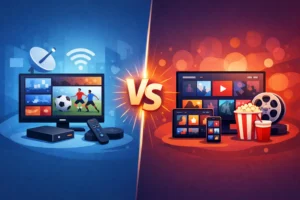
For many households, the best value will come from services that bring live sports together with general entertainment, movies, and series in one package. That is especially true for families and multi-interest homes where one person wants the game, another wants local channels, and someone else wants on-demand shows later that night.
Device flexibility is no longer optional
The future of sports streaming is also a hardware story. Fans do not all watch the same way. Some want a large-screen setup in the living room. Others watch from a phone during a commute, a tablet at work, or a second TV in the basement during overlapping games.
Any provider that expects loyalty has to work across common devices with minimal setup friction. Fire TV, Android boxes, smart TVs, phones, tablets, and STB-style systems all matter because real households mix and match. If the app is hard to install or the stream only works well on one platform, that limitation becomes a deal breaker fast.
This is where practical service design matters more than hype. Instant activation, simple login, multi-device options, and clear support are not side benefits. They directly affect whether a fan gets to the game on time.
That same logic is one reason services built around broad compatibility and high-volume content libraries continue to attract attention. A provider like PureVisionHD fits this shift because it speaks to what sports viewers actually care about: fast access, device freedom, reliable performance, and a simpler way to replace expensive cable habits.
Regional and local coverage will stay crucial
National rights get the headlines, but local loyalty drives viewing habits. Fans care deeply about hometown teams, regional rivalries, and local sports networks. In many cases, that is the content that decides whether a service feels complete.
This matters even more in bilingual and multicultural markets. Households may want U.S. major league coverage, Canadian sports, local news, and international channels in the same setup. The closer a service gets to matching real viewing behavior, the stronger its long-term value.
That is also why sports streaming will not be won by one-size-fits-all products. Different households need different mixes of local channels, league coverage, language options, and device access. The best services will be the ones that understand those habits instead of forcing viewers into narrow bundles.
What fans should expect next
Over the next few years, sports streaming will get better and more frustrating at the same time. Better because picture quality, app design, and device support will improve. More frustrating because rights fragmentation will continue, and premium access will keep getting expensive.
That means fans should judge services with a simple standard. Can you get the sports you care about, on the devices you use, at a price that still makes sense after month three? If the answer is no, the platform is not built for real life.
The services that win will not be the loudest. They will be the ones that make sports easy again – fast start, stable stream, broad access, and less hassle. That is where this market is heading, and viewers should expect nothing less.